How instinctive movement and upright positions may help women cope with labor.

For generations, women across cultures instinctively moved during labor. They walked, swayed, knelt, squatted, leaned on loved ones, and changed positions based on what felt right in the moment. Yet in modern maternity care, many women still picture labor as something that happens primarily while lying in a hospital bed.
New research is helping to challenge that assumption.
A June 2026 systematic review and meta-analysis published in Midwifery examined 12 randomized controlled trials involving 5,439 women to investigate whether movement and position changes during labor could improve birth outcomes. Researchers found that shifting positions was associated with shorter labor, lower cesarean rates, and fewer assisted vaginal births, especially when women used upright positions like squatting combined with movement throughout labor.
Key findings from the 2026 review.
Shorter first and second stages of labor
Lower rates of cesarean birth
Fewer assisted vaginal births
Benefits observed even among women receiving low-dose epidurals
No evidence that lying in bed improved outcomes
The benefits of staying mobile during labor.
As a laboring woman changes positions from standing, to squatting, to kneeling or leaning, she creates more flexibility within the pelvis and allows gravity to assist the baby's descent.
Changing positions can help a baby rotate into the correct position, reducing pressure on sensitive areas. It can be more comfortable and help labor progress more efficiently.
Shifting positions also lets women actively and instinctively respond to contractions.
There is no one “best” position.
One of the most important takeaways from this research is that there isn't a single perfect labor position. What feels supportive during early labor may feel uncomfortable later. A position that helps ease back labor may not be the one a mother chooses during pushing.
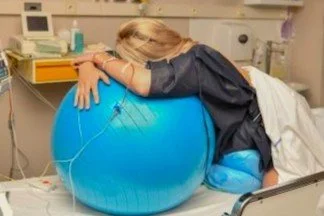
When women have freedom of movement, they naturally rotate through positions such as:
Walking or slow pacing
Standing and swaying
Leaning over a birth ball
Hands and knees
Side-lying rest periods
Squatting during stronger contractions
Kneeling while supported by a bed, chair, or partner
It’s not necessary to commit to one of these positions. The evidence suggests it’s the flexibility of movement itself that’s valuable.
What women often say about positions during labor.
Although the Midwifery review focused on medical outcomes rather than personal experiences, women frequently describe movement as one of the most helpful coping tools during labor.
Common themes include:
Contractions feeling more manageable
Reduced feelings of being "stuck" during labor
Relief from back pressure
Greater sense of control
Feeling more involved in the birth process
Many mothers report that swaying, rocking, kneeling, or changing positions gave them something constructive to focus on during contractions. Others say that listening to their instinct felt natural and supportive.
Can upright positioning during labor reduce tearing?
While research has not conclusively shown that upright labor positions eliminate tearing, newer evidence suggests that specific positions such as squatting and standing may be associated with lower rates of certain types of perineal trauma. Researchers have also found that hands-and-knees positioning may reduce the need for episiotomy, reinforcing the idea that women should be able to find the positions that work best for their bodies.
A 2026 analysis comparing individual birth positions found that standing ranked among the lowest-risk positions for first-degree tears, while squatting ranked among the lowest-risk positions for both second-degree and severe third- and fourth-degree tears. However, when researchers looked at all upright positions together, the differences were not statistically significant, meaning that there is no definitive position that’s best.
For many women, the goal may not be to avoid every minor tear, but rather to create the conditions for a physiologic, supported birth with fewer interventions and greater comfort.
How should expectant mothers decide what's right for them?
How can you find providers who will support your freedom of movement and positioning during labor? Ask your doctor and other care providers these questions during pregnancy:
Do you encourage movement during labor?
Will I be allowed to walk, change positions, and use tools such as birth balls, peanut balls, squat bars, or labor stools?
Will the nursing staff and care providers assist me with changing positions like squatting, standing or kneeling?
Are doulas welcomed to provide physical support during labor?
What options are available if I receive an epidural?
Does the hospital offer wireless monitoring that allows greater mobility?
Notice the attitude and philosophy of your provider when you ask the questions.
Many modern hospitals offer support for movement throughout labor. Many women have active, mobile labor in traditional hospital environments. Some labor and delivery nurses are highly experienced in helping mothers labor on hands and knees, side-lying, kneeling, standing, or squatting.
Birth centers may offer even more freedom of movement. They often focus on supporting physiologic birth rather than medical interventions.
Discuss your wishes with several available providers. Ask your friends and family about their experiences with local providers as well.
Supporting physiologic birth.
For doulas, midwives, nurses, and birth partners, this research is a reminder that effective support does not always require specialized equipment or interventions. Sometimes you can best help a laboring woman by allowing her to feel safe enough to trust her instincts and move in the ways that feel right for her body.
Whether a woman ultimately gives birth standing, squatting, kneeling, side-lying, or resting in bed, the ability to respond to her body's signals may be one of the most valuable tools she has. As evidence continues to emerge, modern research is increasingly supporting what generations of women have known through experience: labor is an active process, and movement often has a role to play.
“Effects of Maternal Movement and Position Changes During Labor on Birth Outcomes in Women Receiving Low-Dose Epidural Analgesia: A Systematic Review and Meta-Analysis,” Midwifery (2026).
“The Evidence Behind Movement During Labor: Walking, Swaying, and Position Changes,“ Birth & Baby University (2026). https://www.birthandbabyuniversity.com/evidence-movement-during-labor-walking-swaying-position-changes/